A fashion designer (CAD) creates garment designs, flats, prints, patterns and 3D samples on computer. This roadmap covers Photoshop, Illustrator, CorelDRAW, pattern CAD, 3D garments and portfolio layout.
Create mood boards, fabric textures, print placements and coloured renderings of your designs, and present collections digitally.
Draw accurate front and back flats, stitch details and spec sheets. Export houses often use CorelDRAW, while many brands and buyers ask for Illustrator files.
Make digital patterns, grade them into sizes and plan markers that reduce fabric waste, the core of CAD work in garment production units.
Sew 2D patterns onto 3D avatars, test drape and fit, and show realistic virtual garments to buyers before any fabric is cut.
Lay out multi-page portfolios, lookbooks, catalogues and tech packs that you can print or send to employers and buyers as PDFs.
Finish the program and its project — you get the course-completion certificate and a digital completion badge with your name.
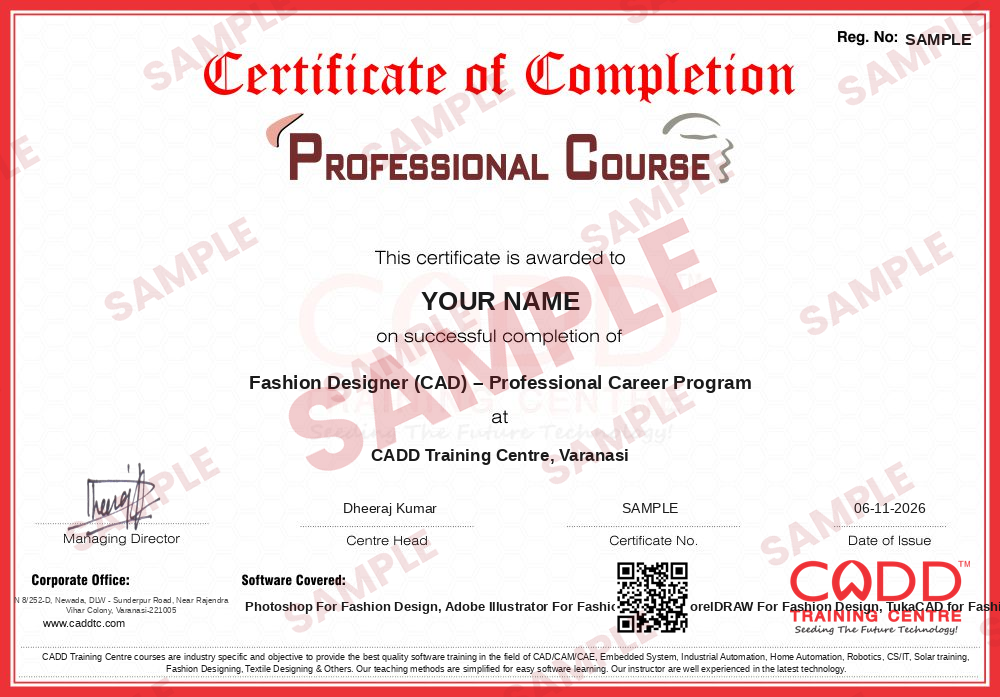
Take the certification exam: a theory test on the software of the program and a practical task of the job — at the centre or online.
Pass the exam and get the certified certificate with your marksheet. Anyone can check it online with its QR code.
Your certified badge — add it to LinkedIn and share it anywhere; it opens its own verify page.

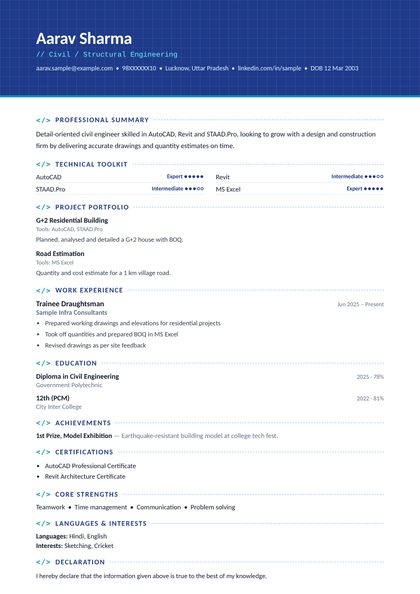
Make your CV in your student panel (Career → My CV) — your program, certificates and projects are added for you. Send it as a link with a preview picture, apply to jobs and answer Hire Me requests from companies.
The counsellor can shorten or extend this plan for your qualification and the time you have. Ask for your personal plan →
Join at the level that suits you — each level is a complete course you can enrol in.
Entry job — the first steps of the roadmap
The whole roadmap — every software of the job
A fashion designer working with CAD uses software to develop clothing from idea to production. Daily work includes drawing technical flats and fashion illustrations, creating mood boards and colourways, placing prints on garments, preparing tech packs with measurements and trims, making and grading digital patterns, planning fabric-saving markers and showing 3D virtual samples to buyers before a physical sample is stitched.
Employers include garment export houses, apparel brands and retail chains, buying houses, pattern-making and sampling units, boutiques, online fashion stores and design studios in hubs such as Delhi NCR, Mumbai, Bengaluru, Tiruppur and Jaipur. Many designers also freelance or run their own labels.
Demand comes from the export and domestic apparel industry moving to digital sampling, faster collections and fewer physical samples. Software skills add to, but do not replace, a feel for fabrics, fit and garment construction, so keep sketching and stitching alongside this roadmap.
Join a fashion design diploma or degree for the creative and construction foundation, and learn CAD alongside: Photoshop and Illustrator or CorelDRAW for design, TukaCAD or Optitex for patterns and Marvelous Designer for 3D. Build a portfolio from your projects.
Photoshop for mood boards and prints, Illustrator and CorelDRAW for flats and illustrations, TukaCAD and Optitex for pattern making, grading and markers, Marvelous Designer for 3D garments and InDesign for portfolios and lookbooks.
About 420 hours: Photoshop 60, Illustrator 60, CorelDRAW 60, TukaCAD 60, Optitex 60, Marvelous Designer 60 and InDesign 60. You can start applying for CAD assistant roles after the first three steps.
In export houses and brands, yes. Buyers expect digital flats and tech packs, and production units grade patterns and plan markers on CAD. Hand sketching still matters for ideas, but files are delivered digitally.
Yes. These courses run in live online classes and classroom batches. You need a computer that can run the software, and 3D garment simulation in particular needs a reasonably capable graphics card.
Both are pattern design systems used for making, grading and marker planning. Optitex also offers integrated 3D visualisation. Different factories use different systems, so knowing both makes you more adaptable.
More questions? Ask our counsellor or see all career roadmaps.
 Architectural Draughtsman & VisualizerAn architectural draughtsman and visualizer prepares working drawings and turns designs into realistic 3D images and walkthroughs. This roadmap covers AutoCAD, Revit, SketchUp, 3ds Max with V-Ray, Lumion and Photoshop.
 Interior DesignerAn interior designer plans functional, attractive spaces and presents them through drawings and realistic 3D views. This roadmap builds your software skills in AutoCAD, SketchUp, V-Ray, 3ds Max, Photoshop and the basics of Vastu.
 Product / Industrial DesignerProduct and industrial designers shape how everyday products look, feel and get made. This roadmap builds surface modelling, design-for-moulding and photoreal rendering skills for a strong design portfolio.
 Web DeveloperA web developer builds and maintains websites and web applications. This roadmap covers HTML, CSS, web graphics, server-side Python and hosting basics so you can create and publish complete sites.
 Graphic DesignerA graphic designer creates logos, posters, social media posts, packaging and videos that communicate a message. This roadmap covers Photoshop, CorelDRAW, Illustrator and Premiere Pro for print and digital work.
 Textile Designer (CAD)A textile designer (CAD) creates print designs, motifs, borders and embroidery files for fabrics, sarees, dress materials and home furnishings. This roadmap covers Photoshop, CorelDRAW and Wilcom digitizing.