Associate Course in Manufacturing (CNC Turning & Milling)
Issued by
CADD Training Cetre
Training
Classroom or live online
How to earn
Complete the course and its project
With your name and year · its own verify link · “Add to profile” on LinkedIn
6
Certification exam
Take the certification exam: a theory test and a practical task — at the centre or online.
7
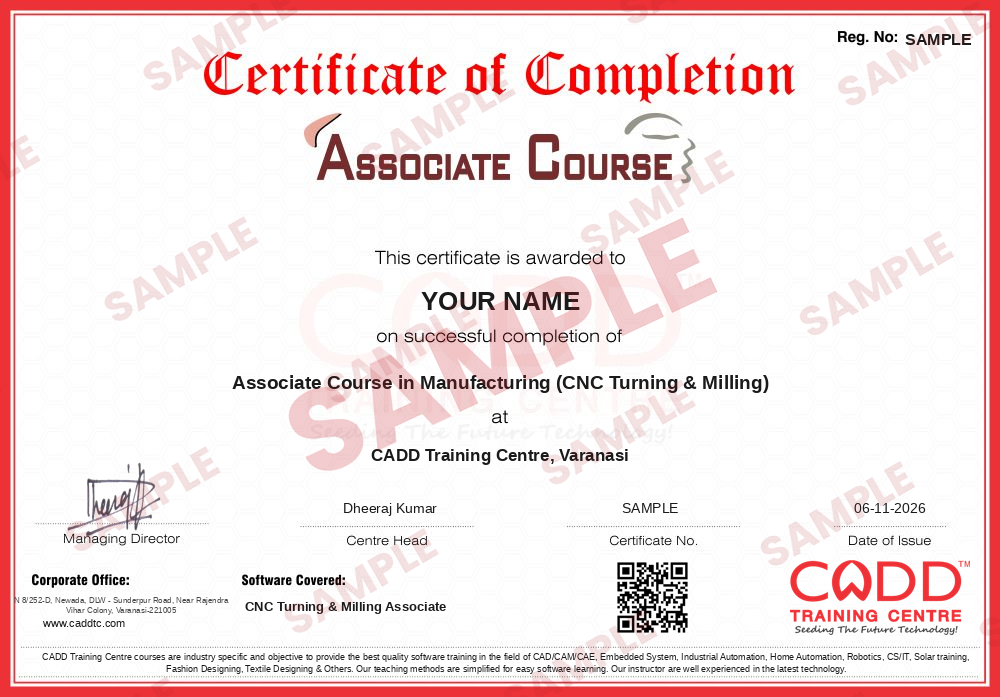
Certified certificate + marksheet
Pass the exam and get the certified certificate with your marksheet. Anyone can check it online with its QR code.
8
Certified badge
Your certified badge — add it to LinkedIn and share it anywhere; it opens its own verify page.
Certified badge
Course
Associate Course in Manufacturing (CNC Turning & Milling)
Issued by
CADD Training Cetre
Training
Classroom or live online
How to earn
Pass the certification exam
You also get
Certified certificate + marksheet
With your name and year · its own verify link · “Add to profile” on LinkedIn
9
Make your CV & apply for jobs
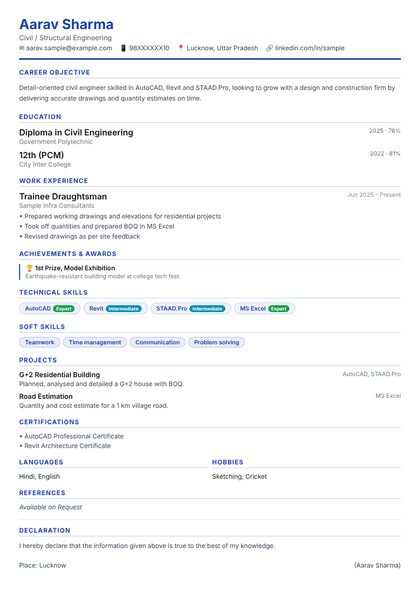
Make your CV in your student panel (Career → My CV) — your course, certificates and projects are added for you. Send it as a link with a preview picture, and apply to jobs and Hire Me requests from companies.
Associate Course in Manufacturing (CNC Turning & Milling)
Duration: 3 Months
After completion of this course and after 2-3 years of field experience the trainee can work as a CNC Machine programmer or supervisor in a CNC machine shop and after 3-5 years of experience, the person can work as a supervisor or Asst Manager in CNC machine shop.
Curriculum
Engineering Drawing
Engineering Metrology
Workshop Technology
Workshop Calculation
Quality Management System
Group Discussion and Personality Improvement (English Speaking) 3-month Regular
CNC Programming & CNC Machining
Computer-Aided Drafting & Design With AutoCAD
Computer-Aided manufacturing with CIMCO Edit
Employability skill
CNC PROGRAMMING AND CNC MACHINING - On Job Training
You will be able to
Read engineering drawings, tolerances and surface finish symbols for machined parts
Measure components with vernier calipers, micrometers, height and bore gauges
Calculate cutting speed, feed, depth of cut and machining time
Write CNC turning programs using G and M codes and canned cycles
Write CNC milling programs with cutter compensation, drilling cycles and subprograms
Set tool and work offsets and run programs safely in dry run and single block
Follow shop-floor quality practices such as 5S, inspection records and ISO 9001 basics
Who it is for
ITI, diploma and B.Tech students in mechanical or production
Conventional machinists who want to move to CNC machines
Fresh job seekers aiming for CNC operator or setter roles
Workers in machine shops who want structured CNC knowledge
What you need
Basic mathematics and willingness to work with machines
Mechanical, ITI or technical background is helpful but not compulsory
A Windows PC for simulator practice if attending live online classes
Courses that include CNC Turning & Milling Associate
Students rate the course after they finish it — their ratings appear here.
CNC Turning & Milling Associate course — FAQ
What is taught in the CNC Turning & Milling Associate course?
The course covers engineering drawing, metrology, workshop technology and calculation, CNC turning and milling programming, machine operation, quality systems and workplace communication.
Who can join the CNC Turning and Milling course?
ITI, diploma and engineering students, conventional machinists and job seekers can join. Basic mathematics is enough; a mechanical background helps but is not required.
What is the duration of the CNC Associate course?
The CNC Turning & Milling Associate course runs for 3 months, combining classroom theory, programming practice and machine or simulator sessions.
Is the CNC course available online or only in classroom?
Both options are available: classroom batches at CADD centres and live online classes. Online learners practise programming on a simulator, and machine work depends on the centre.
Will I get a certificate after the CNC course?
Yes. After the 3-month CNC Associate course you get a CADD Training Centre certificate. Its authenticity can be checked online through the QR code or verification number.
What jobs can I do after a CNC turning and milling course?
It prepares you for entry roles such as CNC operator, CNC setter and quality inspector. With field experience, people grow into CNC programmer and supervisor positions.
Which is better to learn first, CNC turning or milling?
Most trainees start with turning because it uses two axes and is easier to visualise, then move to milling with three axes, work offsets and cutter compensation, as this course does.
What is the difference between the Associate and Professional CNC courses?
The 3-month Associate course builds core programming and operation skills. The 6-month Professional course adds advanced programming, CAM software, GD&T and more shop-floor practice.