Classroom & live online 80 Hours Verifiable certificate Syllabus ↓

Ansys for CFD Course

Learn Ansys CFD with Fluent: geometry, meshing, turbulence, heat transfer, multiphase and post-processing.

Your roadmap — from admission to certificate

  1. Free counselling

    Talk to our counsellor — choose the right course, batch time and mode.

  2. Admission

    Join at a CADD centre near you or online. You get your student login and ID card.

  3. Learn step by step

    80 Hours of hands-on Ansys for CFD classes — in the classroom or live online.

    CFD FundamentalsGeometry and Fluid DomainMeshing for CFDFluent Setup and SolutionTurbulence ModellingHeat TransferTransient and Moving Zone FlowsMultiphase and Species FlowsPost-ProcessingCFD Project
  4. Practice & project

    Exercises in every class and a final project, checked by your trainer.

  5. Course completion certificate + completion badge

    Finish the course and get your course-completion certificate and a digital completion badge with your name.
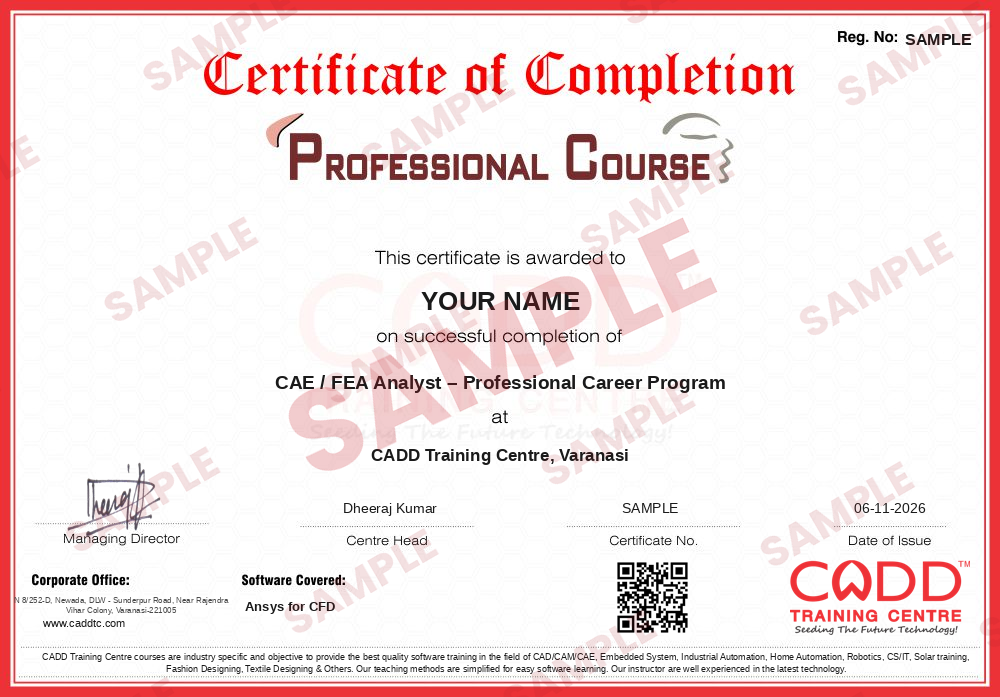

    Sample course-completion certificate — CAE / FEA Analyst – Professional Career Program
    Course-completion certificate (sample) — CAE / FEA Analyst – Professional Career Program · verifiable online
    Course-completion badge — CAE / FEA Analyst – Professional Career Program
    Course-completion badge
    Course
    CAE / FEA Analyst – Professional Career Program
    Issued by
    CADD Training Cetre
    Training
    Classroom or live online
    How to earn
    Complete the course and its project
    With your name and year · its own verify link · “Add to profile” on LinkedIn
  6. Certification exam

    Take the certification exam: a theory test and a practical task — at the centre or online.

  7. Certified certificate + marksheet

    Pass the exam and get the certified certificate with your marksheet. Anyone can check it online with its QR code.

  8. Certified badge

    Your certified badge — add it to LinkedIn and share it anywhere; it opens its own verify page.
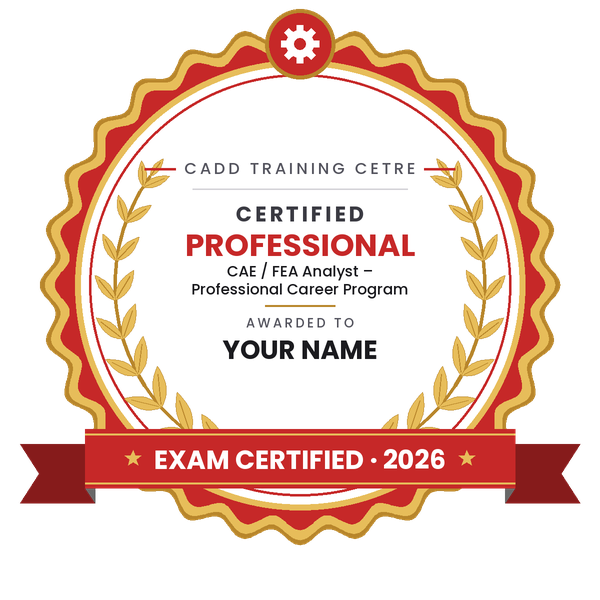
    Certified badge — CAE / FEA Analyst – Professional Career Program
    Certified badge
    Course
    CAE / FEA Analyst – Professional Career Program
    Issued by
    CADD Training Cetre
    Training
    Classroom or live online
    How to earn
    Pass the certification exam
    You also get
    Certified certificate + marksheet
    With your name and year · its own verify link · “Add to profile” on LinkedIn
  9. Make your CV & apply for jobs

    Make your CV in your student panel (Career → My CV) — your course, certificates and projects are added for you. Send it as a link with a preview picture, and apply to jobs and Hire Me requests from companies.

About the Ansys for CFD course

Ansys Fluent is computational fluid dynamics (CFD) software for simulating how air, water, gases and other fluids flow and carry heat. Engineers use it to study pumps, fans, ducts, pipes, heat exchangers, vehicles, HVAC systems and process equipment, predicting pressure drop, velocity, temperature, mixing and multiphase behaviour long before a prototype is built. It is common in automotive, aerospace, power, process and research environments.

The 80-hour Ansys for CFD course builds understanding step by step. You begin with the governing equations, the finite volume method and the Workbench workflow, then prepare internal and external fluid domains in SpaceClaim and mesh them with inflation layers, checking y+ and mesh quality. In Fluent you set up solvers, materials and boundary conditions, monitor residuals and run turbulent flows with k-epsilon and k-omega SST models. Heat transfer, conjugate heat transfer, transient flows, moving reference frames, sliding mesh, VOF multiphase and species transport follow, together with post-processing using contours, vectors, pathlines and reports. A final flow and heat transfer project with mesh independence and a technical report completes the course. Classes are hands-on, in CADD centre classrooms or live online, with an online-verifiable CADD Training Centre certificate.

CFD opens roles like CFD engineer, thermal analyst and HVAC design engineer. Basic fluid mechanics is required, and many learners pair it with Ansys for Structural Analysis.

You will be able to

  • Explain the basics of CFD and choose the right flow model
  • Prepare a fluid domain from CAD geometry in SpaceClaim
  • Create meshes with inflation layers for accurate wall results
  • Set up Fluent cases with materials, boundary conditions and solvers
  • Solve turbulent, heat transfer, transient and multiphase problems
  • Post-process contours, vectors, streamlines and reports
  • Validate CFD results and present them in a technical report

Who it is for

  • Mechanical, aerospace, chemical and thermal engineering students
  • M.Tech and research students doing CFD projects
  • HVAC, pump, turbomachinery and process engineers
  • Ansys structural users moving into fluid simulation

What you need

  • Basic knowledge of fluid mechanics and heat transfer
  • Familiarity with any CAD software is helpful
  • For live online classes: a Windows PC with 16 GB RAM, multi-core CPU and stable internet

Courses that include Ansys for CFD

CAE / FEA Analyst – Professional Career ProgramProfessional Career Program · 360 Hours · 6 software
Enquire →

Ansys for CFD Syllabus

10 chapters · 49 topics
01 CFD Fundamentals 5 topics
  1. What CFD is and where it is used
  2. Governing equations: continuity, momentum and energy
  3. Finite volume method basics
  4. Laminar vs turbulent flow and Reynolds number
  5. CFD workflow in Ansys Workbench
02 Geometry and Fluid Domain 5 topics
  1. Importing CAD into SpaceClaim
  2. Volume extract for internal flow
  3. Enclosures for external flow
  4. Named selections for boundaries
  5. Geometry cleanup and simplification
03 Meshing for CFD 5 topics
  1. Ansys Meshing for fluid domains
  2. Inflation layers and y+
  3. Fluent watertight geometry meshing workflow
  4. Poly-hexcore and tetrahedral meshes
  5. Mesh quality: skewness and orthogonal quality
04 Fluent Setup and Solution 5 topics
  1. Fluent interface and outline view
  2. General settings: pressure-based and density-based solvers
  3. Materials and cell zone conditions
  4. Inlet, outlet and wall boundary conditions
  5. Solution methods, initialisation and residual monitors
05 Turbulence Modelling 5 topics
  1. k-epsilon and k-omega SST models
  2. Near-wall treatment
  3. Pipe and duct flow examples
  4. External flow over a body: lift and drag
  5. Grid independence study
06 Heat Transfer 5 topics
  1. Energy equation and thermal boundary conditions
  2. Conjugate heat transfer
  3. Natural and forced convection
  4. Radiation model basics
  5. Heat exchanger example
07 Transient and Moving Zone Flows 5 topics
  1. Transient time stepping
  2. Vortex shedding example
  3. Moving reference frame for fans and pumps
  4. Sliding mesh basics
  5. Monitoring transient results
08 Multiphase and Species Flows 5 topics
  1. Volume of Fluid (VOF) model
  2. Mixture and Eulerian models overview
  3. Discrete phase model basics
  4. Species transport
  5. Free-surface tank example
09 Post-Processing 5 topics
  1. Contours, vectors and pathlines
  2. Planes, iso-surfaces and probes
  3. XY plots and surface reports
  4. CFD-Post and Fluent results
  5. Animations and images for reports
10 CFD Project 4 topics
  1. Project: complete flow and heat transfer study
  2. Mesh independence and validation
  3. Technical report and presentation
  4. Certificate assessment

Ratings & reviews

Students rate the course after they finish it — their ratings appear here.

Ansys for CFD course — FAQ

What is Ansys Fluent used for?

Ansys Fluent is computational fluid dynamics software used to simulate air and liquid flow, heat transfer, mixing and multiphase behaviour in products such as pumps, ducts, heat exchangers, vehicles and process equipment.

Who should learn Ansys CFD?

Mechanical, aerospace, chemical and thermal engineering students, M.Tech researchers and engineers in HVAC, energy and process industries. Basic fluid mechanics knowledge is needed.

What is the duration of the Ansys CFD course?

The Ansys for CFD course is 80 hours, from CFD theory and meshing to turbulence, heat transfer, multiphase and a final project.

Is Ansys CFD training available online?

Yes, both modes run: classroom batches at CADD Training Centre and live online classes. In Ansys for CFD online sessions you mesh and solve each flow case on your PC while the trainer reviews residuals and results.

Will I get a certificate after the Ansys CFD course?

Yes. Completing the Ansys for CFD course earns you a CADD Training Centre certificate with a QR code and verification code, so a CFD or thermal engineering team can confirm it online.

What jobs need CFD skills?

CFD engineer, thermal analyst, simulation engineer and HVAC design engineer roles in automotive, aerospace, power, process and consulting companies. Career guidance and placement support are included.

What is the difference between Ansys structural and Ansys CFD?

Structural analysis in Ansys Mechanical studies stress and deformation in solids, while CFD in Fluent studies how fluids flow and carry heat. Many engineers learn both to handle coupled problems.

More questions? Ask our counsellor or read the general FAQ.
Ansys for CFD80 Hours
Enquire now