Learn Python for AI & Machine Learning with NumPy, Pandas, Matplotlib & Scikit-learn.
Talk to our counsellor — choose the right course, batch time and mode.
Join at a CADD centre near you or online. You get your student login and ID card.
96 Hours of hands-on Python with NumPy, Pandas & Scikit-learn classes — in the classroom or live online.
Exercises in every class and a final project, checked by your trainer.
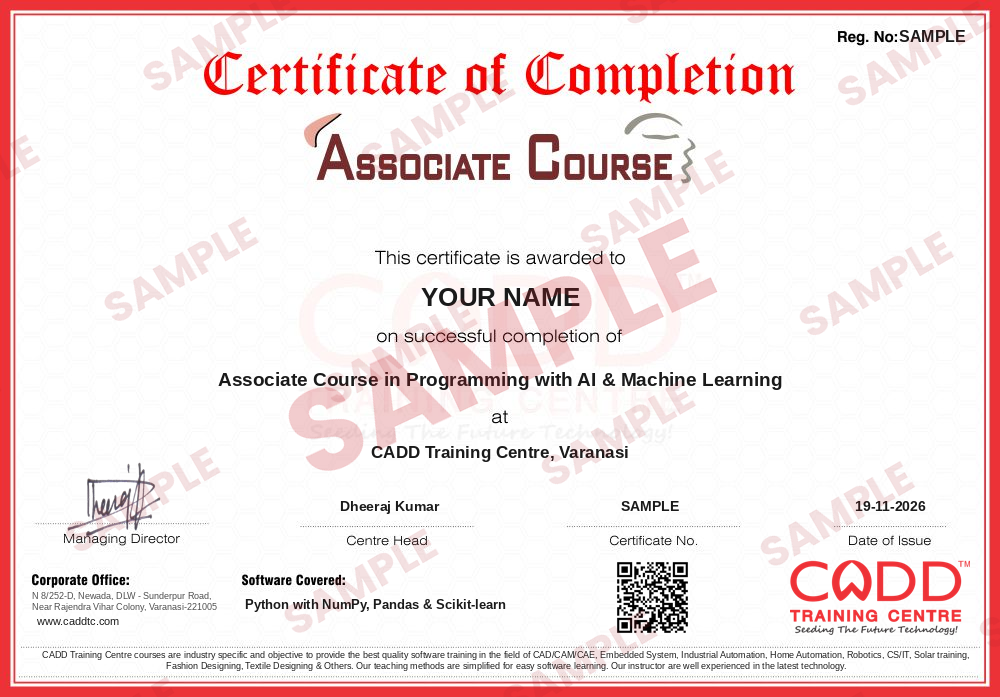
Finish the course and get your course-completion certificate and a digital completion badge with your name.
Take the certification exam: a theory test and a practical task — at the centre or online.
Pass the exam and get the certified certificate with your marksheet. Anyone can check it online with its QR code.
Your certified badge — add it to LinkedIn and share it anywhere; it opens its own verify page.
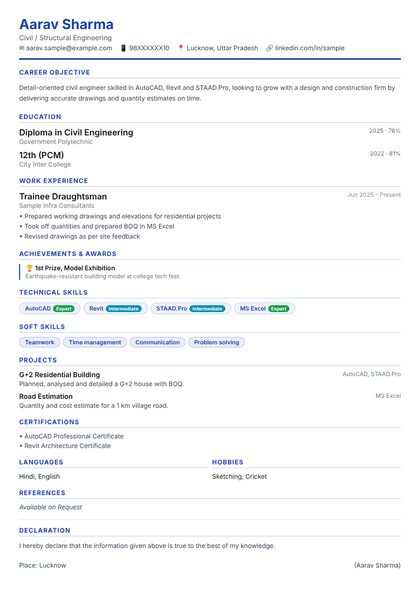
Make your CV in your student panel (Career → My CV) — your course, certificates and projects are added for you. Send it as a link with a preview picture, and apply to jobs and Hire Me requests from companies.
Python is the language of Artificial Intelligence, Machine Learning and Data Science. Almost every AI team in the world uses the same set of free tools: NumPy for fast numbers and arrays, Pandas for cleaning and analysing tables of data, Matplotlib / Seaborn for charts, and Scikit-learn for building Machine Learning models that predict, classify and group. This course teaches all of them, in that order, from zero.
Junior Data Analyst, Python Developer (data), Machine Learning trainee / intern, Business / MIS Analyst, AI support roles -- and the base for advanced Deep Learning, Generative AI and Data Science courses. Engineers and graduates from any branch use these skills to automate reports, analyse project data and add AI to their own field.
Students rate the course after they finish it — their ratings appear here.
A 96-hour course that takes you from zero programming to building real Machine Learning models: core Python, NumPy, Pandas, data visualisation with Matplotlib / Seaborn, and Machine Learning with Scikit-learn, with projects. It is the software of the Associate Course in Programming with AI & Machine Learning.
No. The course starts with installing Python and writing your first program. Basic computer use and school-level maths are enough.
Both, at the foundation level. You learn what AI, Machine Learning and Deep Learning are, then build real Machine Learning models with Scikit-learn, a first neural network and a text classifier. Deep Learning frameworks such as TensorFlow and PyTorch belong to the advanced course that follows.
96 hours -- about 3 months at 1.5 hours a day. Morning, afternoon and evening batches run at the centre and live online; fast-track and weekend batches are possible.
Python 3 with Anaconda, Jupyter Notebook, VS Code, NumPy, Pandas, Matplotlib, Seaborn, Scikit-learn, joblib and Git / GitHub. All of them are free and open source.
House price prediction (regression), student result / placement prediction (classification), customer segmentation (clustering), spam message detection (text + ML) and a capstone project on a data set of your choice. Each one goes to your GitHub portfolio.
Entry roles such as Junior Data Analyst, Python Developer (data), Machine Learning intern / trainee, MIS or Business Analyst. It is also the base for advanced Data Science, Deep Learning and Generative AI courses.
Yes. It covers what most college syllabi touch only in theory -- data handling, model building and evaluation -- with practical projects you can show in interviews and use in final-year projects.
Any Windows 10/11, macOS or Linux computer; 8 GB RAM is recommended, 4 GB works for most classes. No graphics card is needed for this course.
Yes. Live online classes follow the same syllabus with screen sharing, recorded sessions where available, practice assignments and doubt solving.
Yes. After the assessment (theory test + practical project) you get a CADD Training Centre certificate with a QR code that anyone can verify online.
A theory test of multiple-choice questions on Python, NumPy, Pandas and Machine Learning concepts, plus a practical: clean a data set, build and evaluate a model in a Jupyter notebook and explain the result.
More questions? Ask our counsellor or read the general FAQ.