Classroom & live online80 HoursVerifiable certificateSyllabus ↓
C Language Course
Learn C programming from basics: data types, loops, functions, arrays, pointers, structures and file handling.
Your roadmap — from admission to certificate
1
Free counselling
Talk to our counsellor — choose the right course, batch time and mode.
2
Admission
Join at a CADD centre near you or online. You get your student login and ID card.
3
Learn step by step
80 Hours of hands-on C Language classes — in the classroom or live online.
Basics to Start the C programming languageVariables in COperators in CConditionals in CLoops and Errors in CArrays and Strings in CPointers and Memory in CFunctions in CStructures in C
4
Practice & project
Exercises in every class and a final project, checked by your trainer.
5
Course completion certificate + completion badge
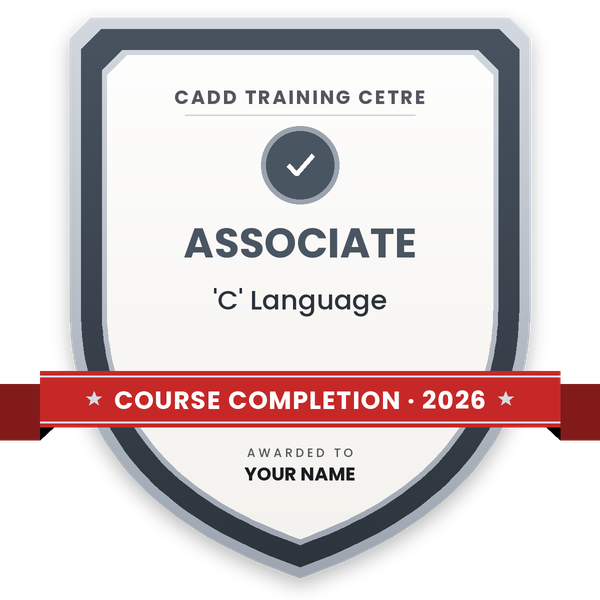
Finish the course and get your course-completion certificate and a digital completion badge with your name.
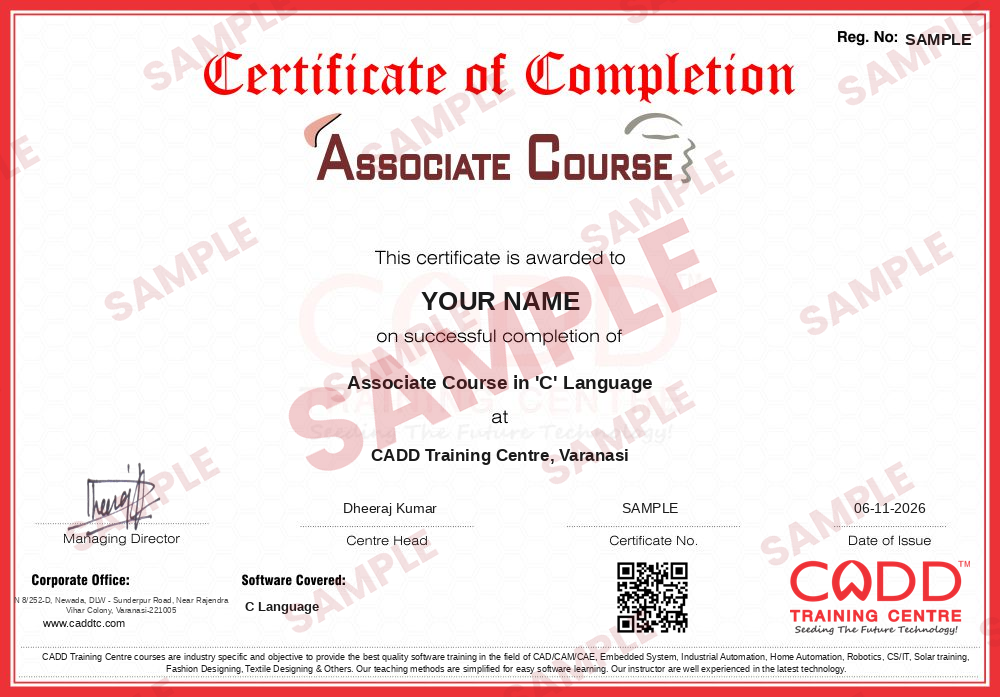
Course-completion certificate (sample) — Associate Course in 'C' Language · verifiable online
Course-completion badge
Course
Associate Course in 'C' Language
Issued by
CADD Training Cetre
Training
Classroom or live online
How to earn
Complete the course and its project
With your name and year · its own verify link · “Add to profile” on LinkedIn
6
Certification exam
Take the certification exam: a theory test and a practical task — at the centre or online.
7
Certified certificate + marksheet
Pass the exam and get the certified certificate with your marksheet. Anyone can check it online with its QR code.
8
Certified badge
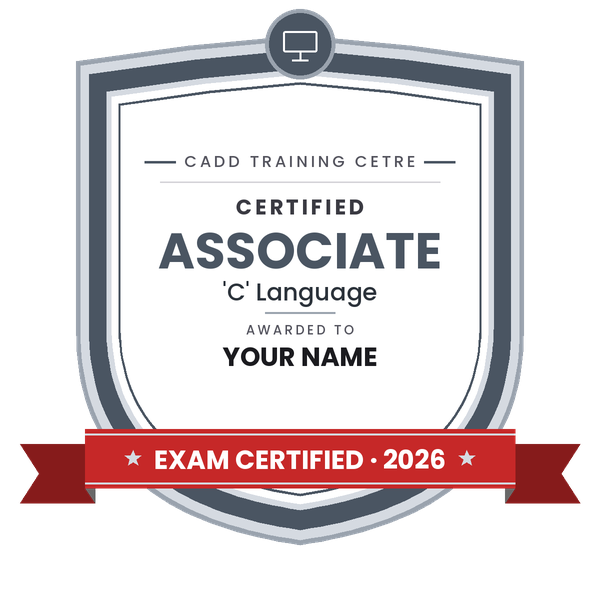
Your certified badge — add it to LinkedIn and share it anywhere; it opens its own verify page.
Certified badge
Course
Associate Course in 'C' Language
Issued by
CADD Training Cetre
Training
Classroom or live online
How to earn
Pass the certification exam
You also get
Certified certificate + marksheet
With your name and year · its own verify link · “Add to profile” on LinkedIn
9
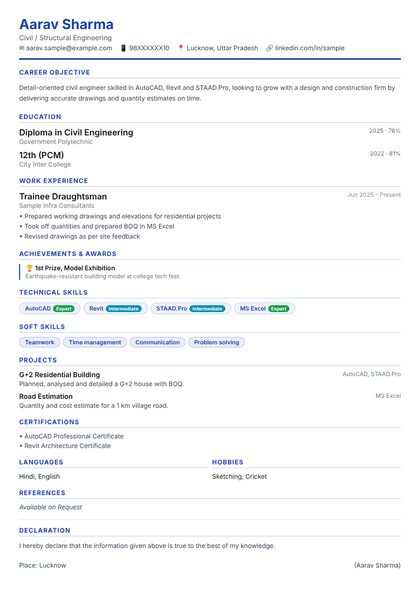
Make your CV & apply for jobs
Make your CV in your student panel (Career → My CV) — your course, certificates and projects are added for you. Send it as a link with a preview picture, and apply to jobs and Hire Me requests from companies.
C has been around for quite some time and it is one of the foundational languages of computer science. Most operating systems today, including the Linux Kernel, are implemented with C code. The main version of the Python programming language is named CPython because it is implemented using C. The C programming language is everywhere, learning it will help you become a better programmer ready for the next challenge in any field of computer science!
This course is a great introduction to both fundamental programming concepts and the C programming language. It will start with those fundamental programming concepts before digging deeper into the more advanced C topics, like pointers and structures.
You will be able to
Write, compile and debug C programs using GCC and an IDE
Use data types, operators, decision statements and loops to solve problems
Break programs into functions and use recursion
Work with arrays, strings and pointers, including pointer arithmetic
Allocate memory dynamically with malloc, calloc, realloc and free
Model data with structures and unions and read and write files
Build a complete menu-driven mini project in C
Who it is for
Class 11 and 12 students with computer science or IT
BCA, B.Sc., B.Tech and polytechnic students starting programming
O Level and A Level students who need strong programming basics
Beginners preparing for C++, Java, embedded systems or data structures
What you need
Basic computer skills and school-level maths
No earlier programming knowledge needed
A Windows PC or laptop with at least 4 GB RAM and a stable internet connection for live online classes
Courses that include C Language
Associate Course in 'C' LanguageAssociate Course · 80 Hours
01Basics to Start the C programming language8 topics+
Introduction about The C Programming Language
First C program - Hello World
Syntax and Errors in C
Output in C
Comments in C
Running your Code using a Compiler.
Summary
Quiz
02Variables in C12 topics+
Let’s Start with Variables
Variables: Naming Standards in C
Data Types in C
printf() in C
let's Practice Naming Standard, Data Types, and printf()
Difference between Float and Double in C
Updating Variables Value in C
Constants in C
Casting Types in C
Summary
Quiz
Project
03Operators in C0 topics+
Topics for this chapter will be added soon.
04Conditionals in C0 topics+
Topics for this chapter will be added soon.
05Loops and Errors in C0 topics+
Topics for this chapter will be added soon.
06Arrays and Strings in C0 topics+
Topics for this chapter will be added soon.
07Pointers and Memory in C0 topics+
Topics for this chapter will be added soon.
08Functions in C0 topics+
Topics for this chapter will be added soon.
09Structures in C0 topics+
Topics for this chapter will be added soon.
Ratings & reviews
Students rate the course after they finish it — their ratings appear here.
C Language course — FAQ
What is C language used for?
C is used to write operating systems, device drivers, embedded and microcontroller programs, compilers and fast system software. It is also the classic first language for learning how programs and memory work.
Is C language good for beginners?
Yes. C teaches core ideas such as variables, loops, functions, memory and pointers clearly. Once you know C, languages like C++, Java and Python become much easier.
How long is the C language course?
The C Language course is 80 hours long. The counsellor will share the batch timings for classroom and live online classes.
Can I learn C programming online?
Yes. You can join live online classes or attend in the classroom at a CADD centre. Online learners install a free compiler such as GCC with an editor on their own PC.
Will I get a certificate after learning C?
Yes. Once you complete the C Language course you get a CADD Training Centre certificate. Mention it on your resume; a recruiter can confirm it online with the QR code or verification code.
Are pointers covered in the C course?
Yes. Pointers are covered in detail: pointer basics, pointer arithmetic, pointers with arrays, strings, functions and structures, and dynamic memory allocation.
What should I learn after C language?
Common next steps are C++ for object-oriented programming, data structures in C, Java or Python, or embedded systems if you are interested in electronics.