A UI/UX designer plans how apps and websites work and look, from user flows and wireframes to polished screens and clickable prototypes. This roadmap covers Photoshop, Illustrator, Figma, HTML and CSS.
Understand layers, masks, colour, typography and layout while editing images and designing banners, so you build an eye for clean, balanced visuals.
Draw icons, logos and simple illustrations as scalable vectors, and learn how to export assets in the sizes and formats that apps and websites need.
Plan user flows, draw wireframes, design final screens with auto layout and components, build a small design system and link screens into a clickable prototype for testing and developer handoff.
Learn how headings, text, images, links, lists and forms are written in HTML, so your designs follow how real web pages are built.
Use CSS for spacing, colours, fonts, Flexbox and Grid layouts and media queries, so you can design screens that work on mobiles, tablets and desktops and talk clearly with developers.
Finish the program and its project — you get the course-completion certificate and a digital completion badge with your name.

Take the certification exam: a theory test on the software of the program and a practical task of the job — at the centre or online.
Pass the exam and get the certified certificate with your marksheet. Anyone can check it online with its QR code.
Your certified badge — add it to LinkedIn and share it anywhere; it opens its own verify page.

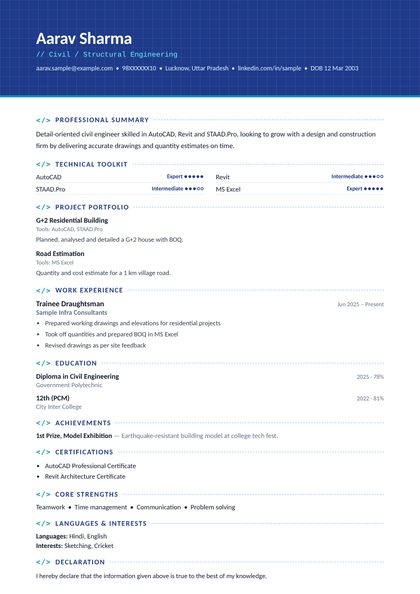
Make your CV in your student panel (Career → My CV) — your program, certificates and projects are added for you. Send it as a link with a preview picture, apply to jobs and answer Hire Me requests from companies.
The counsellor can shorten or extend this plan for your qualification and the time you have. Ask for your personal plan →
Join at the level that suits you — each level is a complete course you can enrol in.
Entry job — the first steps of the roadmap
The whole roadmap — every software of the job
A UI/UX designer decides how a website or mobile app should work and how it should look. UX (user experience) work covers understanding users, planning the steps they take to finish a task and drawing simple wireframes. UI (user interface) work covers the final screens: layout, colours, typography, icons and buttons. On a normal day you might sketch a sign-up flow, design screens in Figma, turn them into a clickable prototype, take feedback from users or the product team and hand finished designs to developers.
UI/UX designers work in IT service companies, software product start-ups, digital agencies, e-commerce, banking and fintech firms, ed-tech companies and in-house teams of businesses that run their own apps. Freelance work on websites and app screens for small businesses is also common.
Almost every business now has a website or an app, and users quickly leave products that are confusing. Companies therefore need designers who can make products simple to use and visually clear, and who understand enough HTML and CSS to design screens that developers can actually build. A portfolio of case studies matters more than any single tool.
Learn design basics in Photoshop and Illustrator, then Figma for wireframes, screens and prototypes, and basic HTML and CSS. Redesign two or three real apps or websites as case studies explaining the problem, your process and the result, and use them as your portfolio.
UX design is about how a product works: user needs, flows and structure. UI design is about how it looks: screens, colours, typography and components. In most Indian companies one designer handles both, especially in start-ups.
You do not need to be a developer, but basic HTML and CSS help a lot. They show you what is easy or hard to build and make your handoff to developers smoother.
Figma is widely used for designing app and website screens because it runs in the browser, supports real-time teamwork and includes prototyping and developer handoff tools in one place.
Each step above shows its own course duration. Most students complete this roadmap in five to seven months with regular classes, and should keep extra time for portfolio case studies.
Yes. CADD Training Centre runs live online classes as well as classroom batches. Figma works in the browser, and you also need a computer that can run Photoshop and Illustrator for the first two steps.
More questions? Ask our counsellor or see all career roadmaps.
 Architectural Draughtsman & VisualizerAn architectural draughtsman and visualizer prepares working drawings and turns designs into realistic 3D images and walkthroughs. This roadmap covers AutoCAD, Revit, SketchUp, 3ds Max with V-Ray, Lumion and Photoshop.
 Interior DesignerAn interior designer plans functional, attractive spaces and presents them through drawings and realistic 3D views. This roadmap builds your software skills in AutoCAD, SketchUp, V-Ray, 3ds Max, Photoshop and the basics of Vastu.
 Product / Industrial DesignerProduct and industrial designers shape how everyday products look, feel and get made. This roadmap builds surface modelling, design-for-moulding and photoreal rendering skills for a strong design portfolio.
 Embedded Systems EngineerAn embedded systems engineer programs the microcontrollers inside electronic products. This roadmap takes you from C and C++ through Arduino hardware, Proteus simulation and Python to entry-level firmware work.
 Python DeveloperA Python developer writes code for web apps, automation scripts and data tools. This roadmap takes you from core Python through web basics, spreadsheets and databases, and cloud concepts towards entry-level developer work.
 Web DeveloperA web developer builds and maintains websites and web applications. This roadmap covers HTML, CSS, web graphics, server-side Python and hosting basics so you can create and publish complete sites.