An embedded systems engineer programs the microcontrollers inside electronic products. This roadmap takes you from C and C++ through Arduino hardware, Proteus simulation and Python to entry-level firmware work.
Embedded firmware is mostly written in C. Learn variables, loops, functions, arrays, pointers and bit operations, which you later use to control pins and registers.
Arduino sketches and many modern firmware projects use C++. Classes and libraries help you write reusable drivers for sensors, displays and motors.
Program real boards: read sensors, drive LEDs, relays and motors, connect displays and modules, and build small working automation and IoT projects.
Draw schematics, simulate microcontroller circuits running your code before building hardware, and lay out simple PCBs, saving time and components.
Use Python to log and plot sensor data, automate hardware tests, talk to boards over a serial port and program single-board computers such as Raspberry Pi.
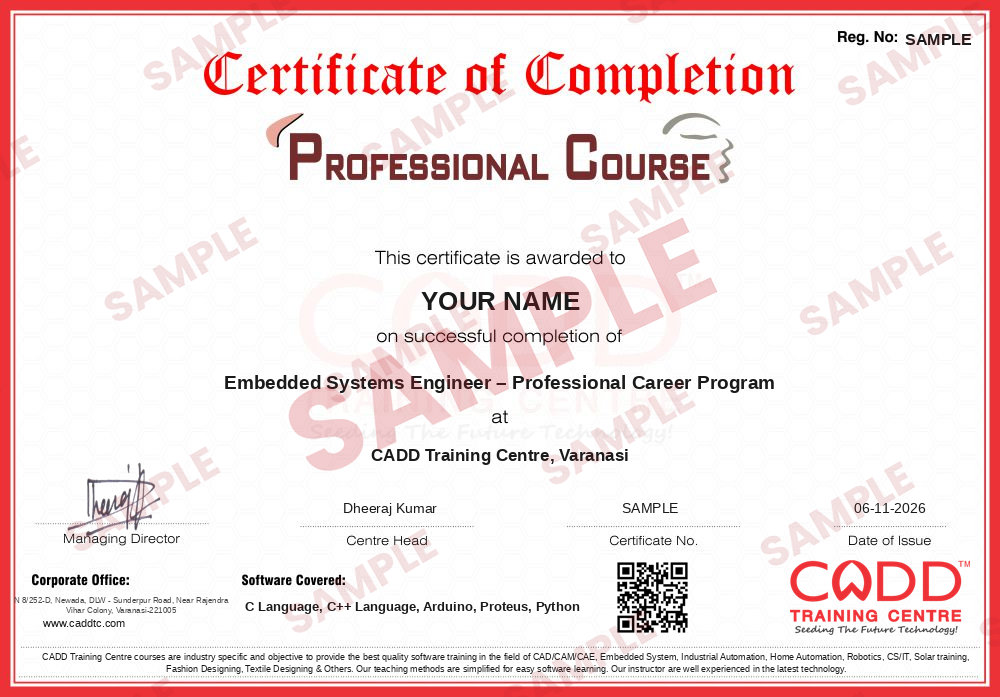
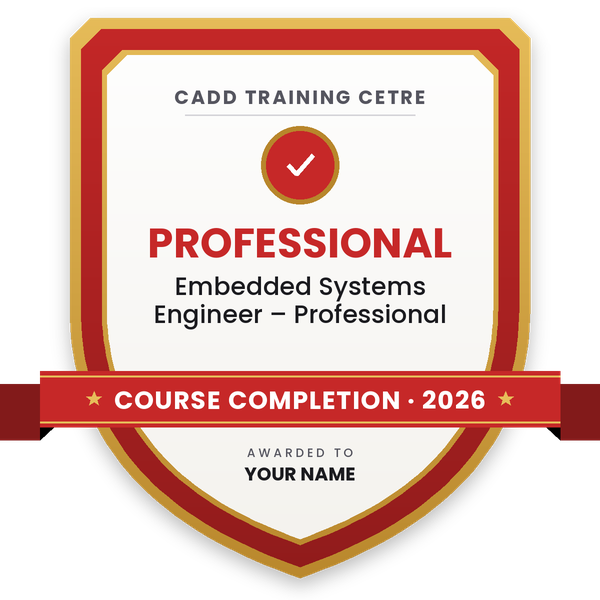
Finish the program and its project — you get the course-completion certificate and a digital completion badge with your name.
Take the certification exam: a theory test on the software of the program and a practical task of the job — at the centre or online.
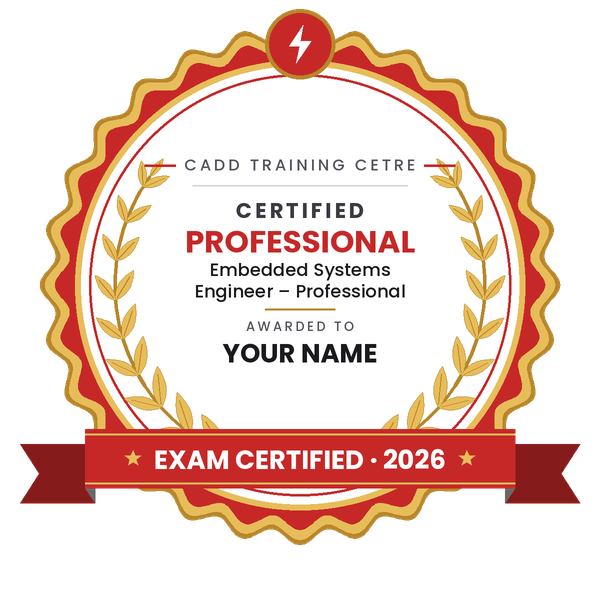
Pass the exam and get the certified certificate with your marksheet. Anyone can check it online with its QR code.
Your certified badge — add it to LinkedIn and share it anywhere; it opens its own verify page.
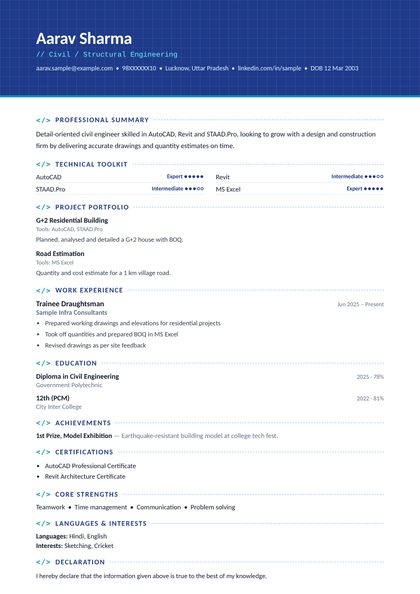
Make your CV in your student panel (Career → My CV) — your program, certificates and projects are added for you. Send it as a link with a preview picture, apply to jobs and answer Hire Me requests from companies.
The counsellor can shorten or extend this plan for your qualification and the time you have. Ask for your personal plan →
Join at the level that suits you — each level is a complete course you can enrol in.
Entry job — the first steps of the roadmap
The whole roadmap — every software of the job
An embedded systems engineer writes the software that runs inside electronic products such as washing machines, smart meters, car dashboards, medical monitors, drones and IoT sensors. A typical day involves writing C or C++ firmware for a microcontroller, reading sensor data, driving motors and displays, testing circuits on a breadboard, simulating designs before the hardware arrives and debugging with a multimeter or serial monitor.
Employers include consumer electronics and appliance makers, automotive and EV companies, defence and aerospace suppliers, telecom and IoT start-ups, industrial automation firms and R&D labs. Many fresh engineers start in product testing or as firmware trainees.
Demand comes from the steady growth of connected devices, electric vehicles and electronics manufacturing in India. This roadmap builds programming first, then hands-on microcontroller and simulation work, then Python for scripting and testing. Professional roles later expect ARM-based controllers, communication protocols such as UART, I2C and SPI, and often an RTOS, which you build on through your own projects.
Strengthen C programming, practise on Arduino boards, learn circuit simulation in Proteus and build two or three working projects you can demonstrate. With an electronics diploma you can start as an embedded trainee or test technician and grow from there.
C is the core language, with C++ widely used. Arduino builds practical microcontroller skills, Proteus is used for schematic simulation and PCB design, and Python helps with test scripts and Raspberry Pi projects.
The five steps add up to about 320 hours: C 80, C++ 80, Arduino 60, Proteus 40 and Python 60. With regular classes that is roughly five to six months, plus your own project time.
Arduino is an excellent start for learning hardware and code together, but companies also use ARM, PIC and other controllers. Once you are comfortable with Arduino, move your projects to other boards and learn register-level programming.
Yes. C, C++, Python and Proteus work well in live online classes. For Arduino you will need a board and a basic component kit at home so you can wire and test circuits yourself.
An electronics, electrical or instrumentation background helps because you must understand circuits. Students from computer science or physics can also enter if they learn basic electronics alongside programming.
More questions? Ask our counsellor or see all career roadmaps.
 Electrical Design EngineerElectrical design engineers prepare schematics, panel layouts and building power and lighting drawings. This roadmap covers AutoCAD, AutoCAD Electrical, Excel load schedules and Revit MEP modelling.
 MEP Design EngineerMEP design engineers plan HVAC, plumbing, fire fighting and electrical services for buildings. This roadmap moves from AutoCAD drafting to AutoCAD MEP, Revit MEP modelling and Navisworks coordination.
 PLC / SCADA Automation EngineerPLC / SCADA automation engineers program the controllers and operator screens that run machines and process plants. This roadmap covers control drawings, Allen-Bradley PLC logic, InTouch SCADA and Python.
 Python DeveloperA Python developer writes code for web apps, automation scripts and data tools. This roadmap takes you from core Python through web basics, spreadsheets and databases, and cloud concepts towards entry-level developer work.
 Web DeveloperA web developer builds and maintains websites and web applications. This roadmap covers HTML, CSS, web graphics, server-side Python and hosting basics so you can create and publish complete sites.
 Java DeveloperA Java developer builds enterprise software, web back ends and Android apps in Java. This roadmap moves from programming logic in C to Core Java, HTML and CSS, Advanced Java and cloud concepts.