A production or manufacturing engineer plans how parts are made, solves shop-floor problems and keeps quality and output on track. This roadmap covers drawing, GD&T, SolidWorks and Solid Edge for production, and CNC machining.
Understand views, sections, dimensions, fits, surface finish and welding symbols, so you can plan manufacturing directly from any customer drawing.
Learn datums and geometric tolerances and how they affect machining setups, fixture design and inspection on the shop floor.
Model parts, assemblies, simple jigs and fixtures and create manufacturing drawings, with a focus on how features will actually be produced.
Learn part, sheet metal and assembly modelling in Solid Edge, another CAD system used in many manufacturing companies, so you can work with any customer's data.
Understand machine axes, offsets, G-code and M-code basics and safe setup of CNC lathes and machining centres, so you can plan and support machining processes.
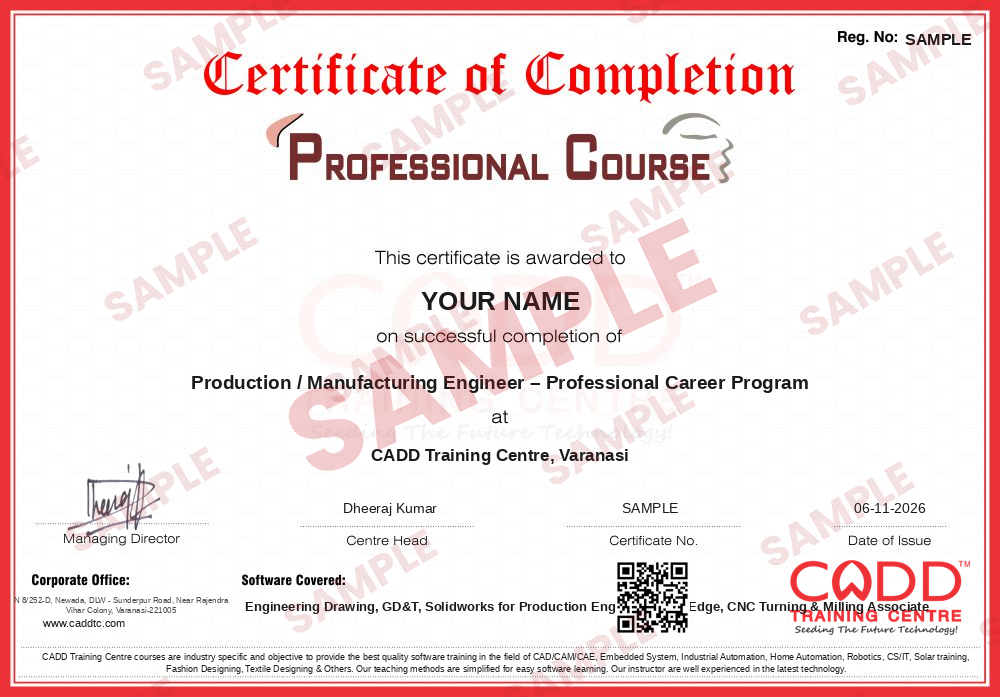
Finish the program and its project — you get the course-completion certificate and a digital completion badge with your name.
Take the certification exam: a theory test on the software of the program and a practical task of the job — at the centre or online.
Pass the exam and get the certified certificate with your marksheet. Anyone can check it online with its QR code.
Your certified badge — add it to LinkedIn and share it anywhere; it opens its own verify page.

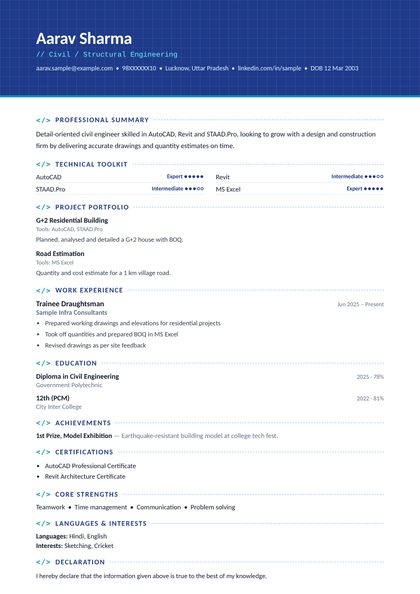
Make your CV in your student panel (Career → My CV) — your program, certificates and projects are added for you. Send it as a link with a preview picture, apply to jobs and answer Hire Me requests from companies.
The counsellor can shorten or extend this plan for your qualification and the time you have. Ask for your personal plan →
Join at the level that suits you — each level is a complete course you can enrol in.
Entry job — the first steps of the roadmap
The whole roadmap — every software of the job
A production or manufacturing engineer is responsible for how products are actually made. The work includes studying part drawings, planning the process sequence, choosing machines, tools, jigs and fixtures, preparing process sheets and work instructions, monitoring daily output and rejections, solving machine and quality problems and improving cycle time and cost.
These engineers work in auto component plants, machine shops, sheet metal and fabrication units, casting and forging companies, consumer goods and electrical equipment factories, and heavy engineering industries in industrial areas across India. The role sits between design, quality, maintenance and the shop floor.
Factories need engineers who can read a drawing and immediately think about how the part will be machined, measured and assembled. Engineers who can also model parts and fixtures in 3D and understand CNC machining can solve problems faster and talk clearly with design and tool room teams. This roadmap builds exactly that practical combination.
Build strong drawing reading and GD&T skills, learn a 3D CAD tool used in manufacturing, and understand CNC machining. A trainee role or internship in a factory then teaches daily production planning and problem solving.
Not every day, but it helps a lot. Production engineers often model fixtures, check customer models, suggest design changes for manufacturing and read 3D data from customers.
Different customers and companies use different CAD systems. Knowing more than one lets you open and work with customer data without depending on the design team.
Yes. Most machined parts today are made on CNC machines, so understanding setups, offsets and programs helps you plan processes, reduce cycle time and solve problems with operators.
The roadmap above usually takes several months. Real production experience then builds the judgement needed to handle the shop floor.
The CAD and GD&T parts can be learned in CADD Training Centre's live online classes as well as in the classroom. Hands-on CNC skills are best built through practical training on machines.
More questions? Ask our counsellor or see all career roadmaps.
 Mechanical Design EngineerA mechanical design engineer turns product ideas into 3D models and manufacturing drawings. This roadmap takes you from drawing basics to SolidWorks modelling, sheet metal, GD&T and simulation.
 Product / Industrial DesignerProduct and industrial designers shape how everyday products look, feel and get made. This roadmap builds surface modelling, design-for-moulding and photoreal rendering skills for a strong design portfolio.
 CAE / FEA AnalystA CAE / FEA analyst uses simulation to predict stress, vibration, heat and fluid flow before a product is built. This roadmap moves from 3D CAD to Ansys structural and CFD work plus result scripting.
 CNC ProgrammerA CNC programmer writes the G-code and CAM toolpaths that run turning and milling machines. This roadmap covers drawing reading, CNC operation, NC editing, part modelling and Mastercam programming.
 Automotive Design Engineer (CATIA / NX)Automotive design engineers create body, trim, chassis and powertrain parts for vehicles. This roadmap builds the CATIA and NX part, assembly and surface skills that carmakers and their suppliers expect.
 MEP Design EngineerMEP design engineers plan HVAC, plumbing, fire fighting and electrical services for buildings. This roadmap moves from AutoCAD drafting to AutoCAD MEP, Revit MEP modelling and Navisworks coordination.